Generator

Where the floats are in the 5-end satin

Where the floats are in the 5-end satin
Where the floats are in the 5-end satin. Every longest run of warp on the face, marked. A float is smooth because nothing interrupts it, which is the same reason it snags: there is a length of thread lying on the surface with nothing holding it down.

Every longest run of warp on the face, marked. A float is smooth because nothing interrupts it, which is the same reason it snags: there is a length of thread lying on the surface with nothing holding it down.

7 essays call float-map. The drawing above is what it returns with no arguments at all; every call below passes it something, because a placement that passes nothing draws whichever member of the family the generator happens to default to rather than the weave its essay argues about.

Where it is called

Changing this generator changes every one of these figures.

Where the floats are in the 5-end satin. Every longest run of warp on the face, marked. A float is smooth because nothing interrupts it, which is the same reason it snags: there is a length of thread lying on the surface with nothing holding it down. Weaves

The float decides

How far a thread runs on the face before it goes under is one number, and it sits behind lustre, drape, snagging, abrasion, tear strength and how densely the cloth can be set. Almost nothing else in the subject has that reach.
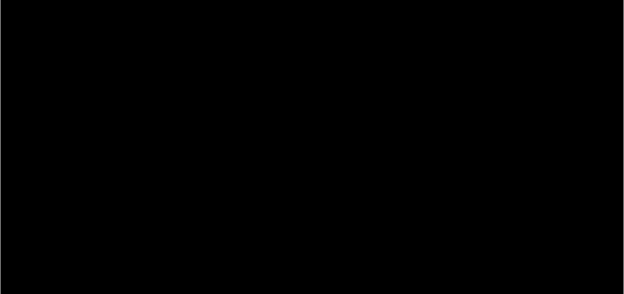
One break, two outcomes. The same single break in a knit and in a weave. In the knit nothing holds the loop above the break, so the failure climbs the wale; in the weave every other thread is still held by the threads crossing it, and one thread comes loose. Knits and other structures

Ravel, fray and run

Cut a woven cloth and one thread comes loose. Break one loop in a knit and every loop above it follows. The two structures fail in opposite ways, and the reason is topology rather than strength.

The 2/2 twill. The 2/2 twill on point paper, a filled square meaning the warp is on the face. Its longest float, its interlacing count and the number of separable cloths it describes were all counted from the matrix that drew it. Pattern and colour

The diagonal is not a thread

A twill's diagonal is the most looked-at feature in weaving and the most misdescribed. No thread in the cloth runs diagonally. What runs diagonally is a pattern of which thread is on top, which is a different sort of object.
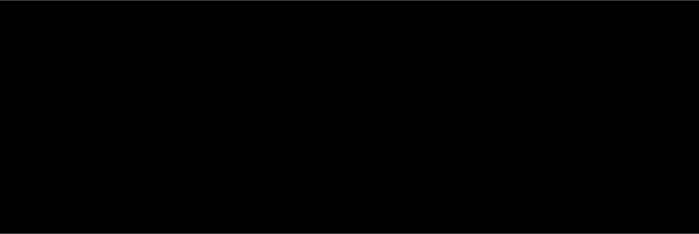
Corduroy: floats of 6 ends, cut. 3 wales of an extra weft floating over 6 warp ends each, cut at their midpoints so that each half stands away from the ground. The pile height is half a float's length and nothing else decides it, so a finer sett at the same float count gives a shorter pile; the wale spacing is the float plus its binding ends. Compound and figured cloths

Corduroy is a cut float

An extra weft floats over some ends, a knife runs along the cloth, and each half of the float stands up. So the pile height is exactly half the float's length — which makes corduroy the one pile fabric whose surface is decided entirely by a quantity this site has been counting since its first essay.

single float as an array. One cell per needle per course, over 2 repeats each way. K knits a new loop and casts the old one off, T tucks the yarn into the loop below without casting off, M misses the needle and floats past it. The margins carry the two conditions: a wale with no K in it never casts off, and a course with no K in it is never caught by anything. Both hold here. Knits and other structures

The float in a knit

Five rungs of this anchor have taken the float to be a length of thread on the surface with nothing holding it down. A knit has one too, and it behaves the same way in the light and the opposite way in the hand — because a woven float lengthens its thread and a knitted one shortens its fabric.

A 3-pick fold across a 8-end satin, move 3. A 8-end satin, move 3 on point paper with a fold 3 picks wide drawn across it at pick 3. A warp end's crimp is made where it turns from over to under, and the dots mark the turns that fall inside the fold. Averaged over the ends there are 0.75 of them, and 4 of the 8 ends in the repeat have none at all — those ends are marked with a line, and each of them crosses the fold dead straight with no crimp to give up. Over every fold position, 50.0% of end-and-place pairs are like that. What the drawing cannot show is what happens to those ends instead, which is that the whole of the fold's length difference goes into their fibres. Weaves

How sharply a weave lets a cloth fold

A fold's length difference is paid for out of crimp, and crimp is not spread evenly along a thread — it is made at the interlacings and nowhere else. So what a fold has to spend is not the weave's average crimp but whatever is inside the few picks the fold crosses, and in an eight-end satin half the warp ends have nothing there at all.

One pick of a 2/2 twill made in the wrong shed. Pick 2 of a 2/2 twill laid in the shed belonging to another pick. The thread is there, it is beaten up in its place, and it is simply not the pick the design asked for — so the fault is a bar the whole width of the cloth and one pick deep. This one leaves the cloth sound, with its longest float at 3. Across every four-by-four draft and every possible wrong shed — 1,372,440 substitutions — 63.2% leave a cloth that still hangs together, 36.6% leave a thread loose, and 0.25% split the cloth. The same wrong shed is harmless in one draft and destroys another, so nothing about the size of the mistake predicts the size of the fault. Weaves

A mispick is one row in the wrong place

Every four-by-four draft, with each of its picks replaced by every shed the loom could have made instead: a million and a third substitutions. Two thirds leave a cloth that still hangs together, a third leave a thread held by nothing, and the same wrong shed is harmless in one draft and fatal in another.

The whole library · All essays